Salary Grade Philippines SG 1 to SG 33 Fully Explained

If you work for the Philippine government, or you plan to work there someday, you have probably heard the term “salary grade.” This number tells you how much money you get every month. The Salary Grade Philippines system gives every government job a number.
That number decides your pay. In this guide, we will explain how it works in simple words. You will know what your salary grade means and where your job fits in.
Knowing the Salary Grade Philippines chart can also help you plan your career, compare jobs, and read your pay slip without confusion.
What Is Salary Grade?
Salary Grade, often shortened to SG, is the system the Philippine government uses to set pay for its workers. Every government job, from a clerk to the President, has a specific grade.
The system goes from SG 1, the lowest, to SG 33, the highest. This is what the Salary Grade Philippines system looks like in practice. This setup comes from the Salary Standardization Law. T
he goal is simple: workers doing the same kind of job should get the same pay, no matter which office they work in. This keeps things fair for everyone across the country.
How the Salary Grade System Works
Each salary grade is not just one fixed amount. Instead, it has eight pay levels called “steps.” A new employee usually starts at Step 1 of their grade.
After three years of good, continuous service in the same position, the employee can move up to the next step. This means their pay grows slowly over time, even without a promotion.
Because of this, it’s a good idea to check the latest Department of Budget and Management (DBM) circulars before relying on any specific number.
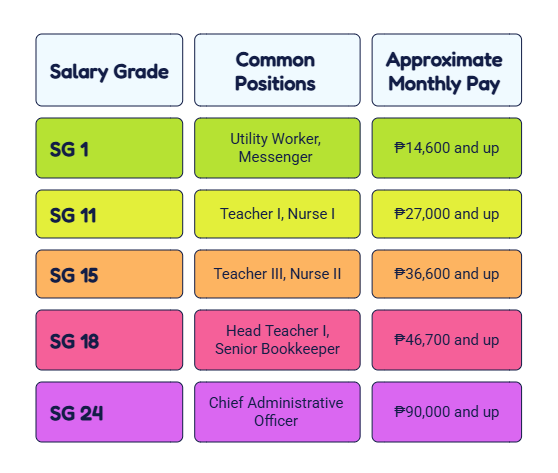
Sample Salary Grade Table
Salary Grades for High-Ranking Officials
The highest salary grades belong to the country’s top leaders and officials. Here’s a general idea of how these top grades are arranged:
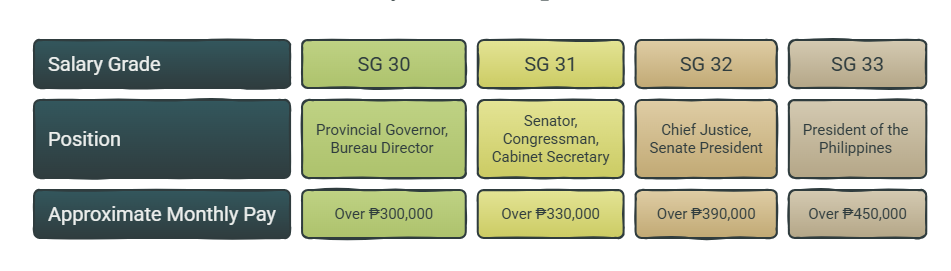
These figures can shift slightly depending on the current salary schedule in effect, so always check official DBM sources for the most accurate numbers.
Next Read: PUP Grading System
Does Salary Grade Apply to Everyone the Same Way?
Not exactly. National government workers follow the standard pay schedule directly. But workers in Local Government Units, or LGUs, may get slightly different pay.
This depends on how much money the LGU earns. Still, every LGU must follow the rules set by the DBM, so pay cannot go too far from the standard. The Salary Grade Philippines system also covers Government-Owned and Controlled Corporations, or GOCCs.
Some GOCCs have their own pay rules, but many are now being moved to follow the same standard salary grade system as other government workers.
Why Salary Grade Matters
Understanding your salary grade is useful for a few reasons.
First, it helps you know what to expect financially before accepting a government job.
Second, it helps you plan your career, since moving to a higher position usually means moving to a higher salary grade.
Third, it helps during salary negotiations or when applying for promotions, since you can clearly see how much a higher grade pays compared to your current one.
FAQs
Final Thoughts
The Philippine salary grade system might look complicated at first, but it follows a clear and organized structure.
Once you know your salary grade, you can quickly estimate your pay range and understand how your position compares to others in government service.
For the most accurate and updated figures, always refer to the latest official release from the Department of Budget and Management.