College Grade Equivalent in the Philippines

Got your grades back and saw a “1”? That’s actually amazing — congratulations!
Philippine colleges grade differently from most countries. A 1.00 is the best score you can get. A 5.00 means you failed. Yes, it’s the opposite of what most people expect.
Understanding your college grade equivalent matters — whether you just got your first report card, want to make the Dean’s List, or need to send your grades to a school abroad.
This 2026 guide explains it all in plain, simple terms.
What is a College Grade Equivalent in the Philippines?
A college grade equivalent is a method used to match local numerical grades with percentage points, descriptive remarks, or international grade point averages (GPA).
Why Grade Equivalents Matter
Understanding these equivalents prevents unnecessary panic. For instance, a student unaccustomed to the system might see a “1.50” on their portal and worry that they are failing.
In reality, that score represents an outstanding achievement. Clear grade equivalence tracking also helps students protect their status for scholarships and retention programs.
College Grade Equivalent vs GPA
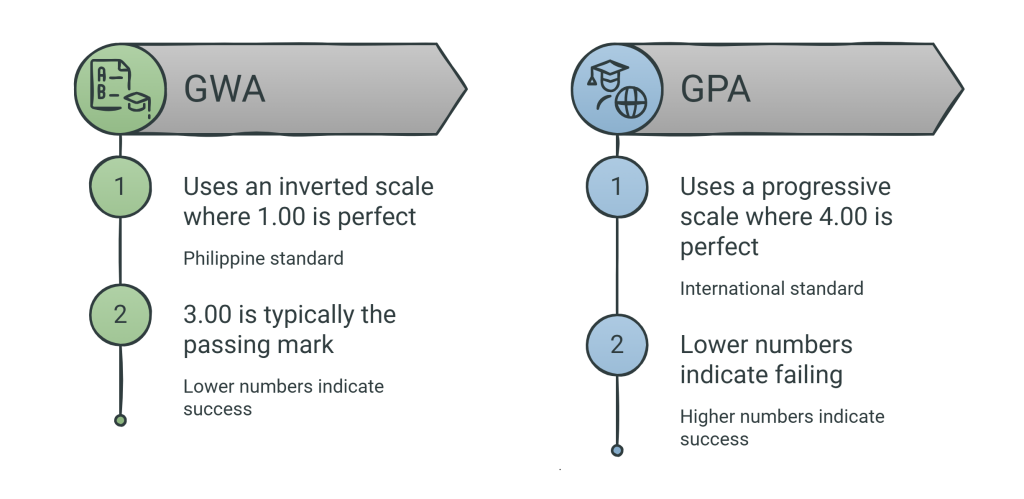
It is crucial not to mix up the local system with the American GPA scale:
- Philippine System: Uses a 1.00 to 5.00 inverted scale, where 1.00 is the highest possible score.
- International GPA System: Uses a 0.00 to 4.00 progressive scale, where 4.00 is the highest possible score (usually an A).
Grading System in the Philippines
- Standard College (CHED): Inverted 5-point scale (1.0 = best, 3.0 = passing/75%).
- Standard High School (DepEd): Percentage scale (60–100); 75 is the minimum passing grade.
- Zero-Based Grading: Used by many top colleges; no base points are added to raw scores.
Alternative Systems
- Elite Private Universities: Use letter grades or a 4.0 scale.
- PSHS: Uses a 1.00 (excellent) to 5.00 (failing) scale.
- International Schools: Often use the IB 1–7 scale.
College Grade Equivalents in the Philippines (Reference Table)
The matrix below serves as a general reference table for standard Philippine colleges during the 2026 academic cycle.
| PH Grade | Percentage | Remarks | US GPA ≈ |
|---|---|---|---|
| 🏅 Excellent | |||
| 1.00 | 97–100% | Outstanding | 4.00 A+ |
| 1.25 | 94–96% | Superior | 3.75–3.99 A |
| ⭐ Very Good | |||
| 1.50 | 91–93% | Very Good | 3.50–3.74 A− |
| 1.75 | 88–90% | Above Average | 3.25–3.49 B+ |
| 👍 Good | |||
| 2.00 | 85–87% | Good | 3.00–3.24 B |
| 2.25 | 82–84% | Satisfactory | 2.75–2.99 B− |
| 📋 Satisfactory | |||
| 2.50 | 79–81% | Satisfactory | 2.50–2.74 C+ |
| 2.75 | 76–78% | Fairly Satisfactory | 2.00–2.49 C |
| ✅ Minimum Pass | |||
| 3.00 | 75% | Passing | 1.00–1.99 D |
| ⚠️ Conditional | |||
| 4.00 | 70–74% | Incomplete | E / Condition |
| ❌ Failed | |||
| 5.00 | Below 70% | Failed | 0.00 F |
Read more: GWA calculator College for College Students
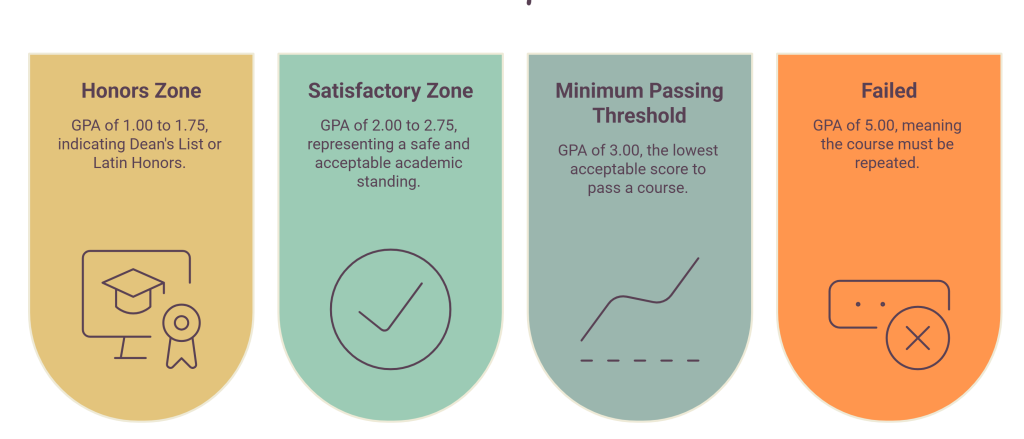
What Each Grade Range Means
Understanding the psychological and academic “zones” of your transcript helps you assess your standing.
How to Compute GWA in College Philippines
Your General Weighted Average (GWA) is the cumulative metric used to evaluate your overall performance across all terms.
GWA Formula
The GWA calculation weights your grades based on the credit units assigned to each course:
$$\text{GWA} = \frac{\sum (\text{Grade} \times \text{Units})}{\sum \text{Units}}$$
Step-by-Step Example
Let us calculate a sample semester transcript for a student taking four classes:
- Class A (Math): Grade of 1.50 $\times$ 3 Units = 4.50
- Class B (English): Grade of 1.75 $\times$ 3 Units = 5.25
- Class C (Science): Grade of 1.25 $\times$ 4 Units = 5.00
- Class D (History): Grade of 2.00 $\times$ 3 Units = 6.00
- Total Grade Points: $4.50 + 5.25 + 5.00 + 6.00 = 20.75$
- Total Units: $3 + 3 + 4 + 3 = 13$
$$\text{GWA} = \frac{20.75}{13} = 1.596$$
GPA vs. GWA: Key Differences
- Official Verification: Avoid manual conversions. Use platforms like WES or Scholaro for certified international grade evaluations.
Latin Honors Benchmarks
To qualify for honors, students must maintain specific cumulative GWA ranges throughout their degree:
| Honor | GWA Range |
| Summa Cum Laude | 1.00 – 1.20 |
| Magna Cum Laude | 1.21 – 1.45 |
| Cum Laude | 1.46 – 1.75 |
Scholarship Requirements
- CHED Scholars: Must maintain a minimum term GWA of 2.50 (or 80%).
- Private Scholarships: Often stricter, frequently requiring a GWA above 1.75 with no single grade below 2.00.
University Grading Styles
While most follow the CHED 1.00–5.00 inverted scale, specific schools use unique increments:
- PUP: Uses a precise 0.10 decimal increment (e.g., 1.10, 1.20).
- UST: Uses a 0.25 fractional scale (e.g., 1.25, 1.50).
- Standard Institutions: Schools like OLFU, ICCT, University of Cebu, Arellano, Adamson, AMA, BatStateU, BulSU, and the University of Iloilo generally follow the standard CHED-aligned inverted 5-point system.
International Grading Comparisons
- Lower Second (2:2): 2.01 – 2.50
- United States: Matches a Philippine 1.00 to an A+ and a 3.00 to a D.
- Australia: Maps a Philippine 1.25 to their High Distinction (HD) tier.
United Kingdom:
- First-Class Honors: 1.00 – 1.50
- Upper Second (2:1): 1.51 – 2.00